AI outbound tools are built around a seductive premise: automate the workflow, reduce headcount, and scale revenue without adding people. Some teams take this literally. They wire up a sequence, turn off the review steps, and let the system run. What they tend to find, usually after some pipeline damage, is that the cost of removing human judgment entirely is higher than the cost of keeping it in the right places.
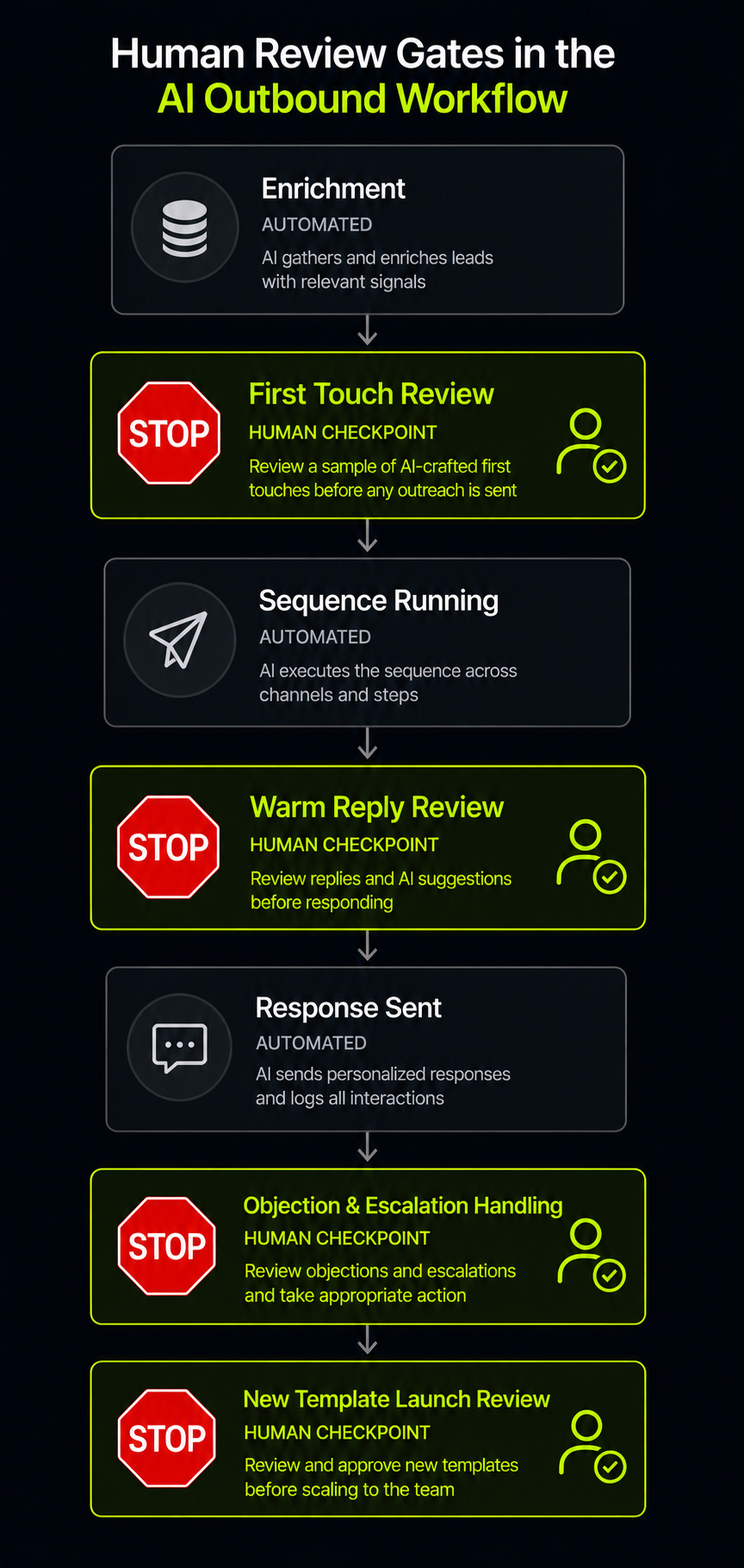
The teams that run AI outbound well understand a different framing. The goal is not maximum automation. It is precision about which parts of the workflow require judgment and which do not. The parts that do not (data enrichment, sequence scheduling, reply routing on clear-cut cases, list hygiene) should run without human involvement. The parts that do require judgment should never run without it.
A human review gate is a defined checkpoint in an AI-assisted outbound workflow where a person reviews the AI's output before it proceeds. Review gates are not about slowing down the system. They are about ensuring that the moments where an AI error has the highest cost are the same moments where a human is in the loop.
- Full automation is not the goal. The goal is removing human involvement from the parts of the workflow that do not require it, while keeping it firmly in the parts that do.
- Review gates are defined in advance, not applied reactively. A workflow without defined checkpoints will skip them under pressure. The gates need to be built into the system architecture, not left to individual judgment.
- The minimum review gates: first touch, warm replies, and personalization sampling. These three cover the highest-cost AI failure modes in most outbound systems.
- Review is not the same as rewriting. The human is checking for errors and approving AI output, not producing the content from scratch. The efficiency gain is preserved.
- AI errors in outbound are often silent. A prospect who receives a bad first impression does not tell you. They just do not respond. Review gates are the only reliable way to catch errors before they reach your best prospects.
Why AI errors in outbound are particularly costly
In most software systems, an error produces a visible failure: a crash, an error message, a failed transaction. In AI outbound, the failure mode is silence. A prospect who receives an email with a factual error, an off-tone opening, or a misapplied signal does not reply to tell you something went wrong. They simply do not respond. The email sits in their inbox as evidence of a bad first impression, and the opportunity closes without you knowing why.
This is what makes AI outbound errors expensive in a way that is not immediately visible in the metrics. The reply rate goes down. The meeting rate goes down. The cost per meeting goes up. But the root cause (AI errors reaching prospects without review) is invisible unless you are actively looking for it.
Review gates are not a safeguard against catastrophic failure. They are a safeguard against the quiet, gradual erosion of outbound performance that happens when errors compound across hundreds of contacts over weeks.
The cost of a review gate is minutes. The cost of skipping one is a prospect who received a bad first impression who will never tell you about it.
The minimum review gates in a healthy workflow
First-touch review. Before any new prospect receives their first email from your sequence, a human should have seen it. This does not mean reading every email line by line at high volume. It means reviewing a representative sample before the sequence launches and setting a threshold for what passes. The goal is catching systematic errors in the personalization logic before they reach your entire list, not approving every individual email manually.
Warm reply review. Any reply classified as interested, meeting-ready, or ambiguously positive should go to a human before the system responds. This is non-negotiable. The risk of an automated response to a genuinely warm reply is too high. The prospect concludes they are talking to a bot, and the trust built through the personalized outreach disappears in a single automated message. Speed matters here: a warm reply reviewed and responded to within two hours converts at a significantly higher rate than one that sits in a queue until the end of the day.
New sequence launch review. Before any new sequence template is run at scale, a human should review the full sequence: all touches, all angles, the complete message arc. A single error in a template that runs to 300 accounts is 300 prospects receiving the wrong message. Reviewing at the template level, before launch, is far more efficient than catching it afterward.
Objection and escalation handling. When a prospect replies with a substantive objection (not a form rejection, but a genuine concern about price, timing, or fit), that reply should never be handled by an automated response alone. Objections contain information about what the prospect is actually thinking, and that information is more valuable if a human reads it and decides how to respond than if it is routed to a templated objection-handler.
What review gates are not
A review gate is not a manual approval of every email the system generates. That removes the efficiency benefit entirely and defeats the purpose of the AI layer. The review is targeted: a human checks the output at defined moments and confirms it meets the standard before it proceeds. For most gates, this is a minutes-long task: scanning a sample of first touches, reading a warm reply and writing a response, reviewing a new sequence before launch.
The human is acting as a quality controller, not a content producer. The AI has done the research, the drafting, and the routing. The human is confirming that the output is accurate, on-tone, and appropriate for the account before it sends. That distinction is what makes the review gate efficient rather than a bottleneck: one person can cover a much larger workflow by reviewing decisions than by making them.
Building gates into the system, not the process
The most common failure mode in review gate design is making them optional. When a review gate is a step someone is supposed to do rather than a step the system requires, it gets skipped, especially under pressure, when the list is large, or when the rep is stretched. The human element is exactly what gets cut when time is short.
Well-designed review gates are enforced by the workflow architecture, not by individual discipline. The sequence does not send until a human approves the first touch. The warm reply does not receive an automated response until the classification is confirmed. The new template does not launch until the review is logged. These are system constraints, not process guidelines. The difference is whether the gate actually holds when things get busy.
A final note: the right set of review gates will vary based on your team size, sequence volume, and the risk profile of your target accounts. A small team running 50 sequences a week can maintain more manual oversight than one running 500. The principle is the same regardless of scale: define which moments require human judgment before you build the automation, not after the first error reaches a prospect you cannot afford to lose.

Questions on human review gates
A human review gate is a defined checkpoint where a person reviews AI output before it proceeds to the next step. Rather than allowing the system to operate end-to-end without oversight, review gates insert human judgment at the moments where the cost of an AI error is highest, typically before first contact with a new prospect, before responding to a warm reply, and before any automated action that is difficult to reverse.
At minimum: first-touch review before a new sequence contacts a prospect for the first time; warm reply review before the system responds to anyone classified as interested or meeting-ready; and new sequence launch review before any template runs at scale. Teams running larger volumes should also maintain personalization quality checks, sampling AI-generated emails before send to catch systematic errors early.
Well-placed review gates add a small amount of time in exchange for a significant reduction in costly errors. The time cost is low because the review is targeted: a human is only checking the output that requires judgment, not re-doing the work the AI has done. The efficiency gain is that one person can cover a much larger workflow by reviewing decisions rather than making them from scratch. Review gates are not a tax on automation. They are what makes automation safe enough to trust at scale.
The most common outcomes: factual errors in personalized emails reach high-priority prospects, creating a negative first impression that is hard to recover from; interested replies get automated responses instead of human follow-up, killing warm opportunities; and systematic errors in a sequence template propagate across the entire list before anyone notices. These failures are usually silent. The prospect simply does not respond, which is why they can compound for weeks before the team realizes something is wrong.
Reply Classification: How AI Handles the Inbox
Interested, not now, wrong person, objection: each requires a different response.
Multi-Touch Sequencing: Why Persistence Is a Strategy, Not a Tactic
Most replies in B2B outbound come after touch four through eight. Most teams stop at one or two.
AI Personalization at Scale: Relevance Without the Manual Work
Manual personalization does not scale. Generic templates do not convert. Here is how AI closes that gap.
Building GTM at a B2B startup? I am running a limited number of free 30-minute calls this quarter for founders and first GTM hires who want a second opinion on their outbound setup. No pitch. Just a direct conversation about what you are working with.
Book a Call