The timing problem in B2B outbound is not just about which accounts to reach. It is about when to be in front of them. A prospect who is not ready on touch one is not gone. They are on a timeline you cannot see. The function of a multi-touch sequence is to stay present long enough for that timeline to intersect with your outreach.
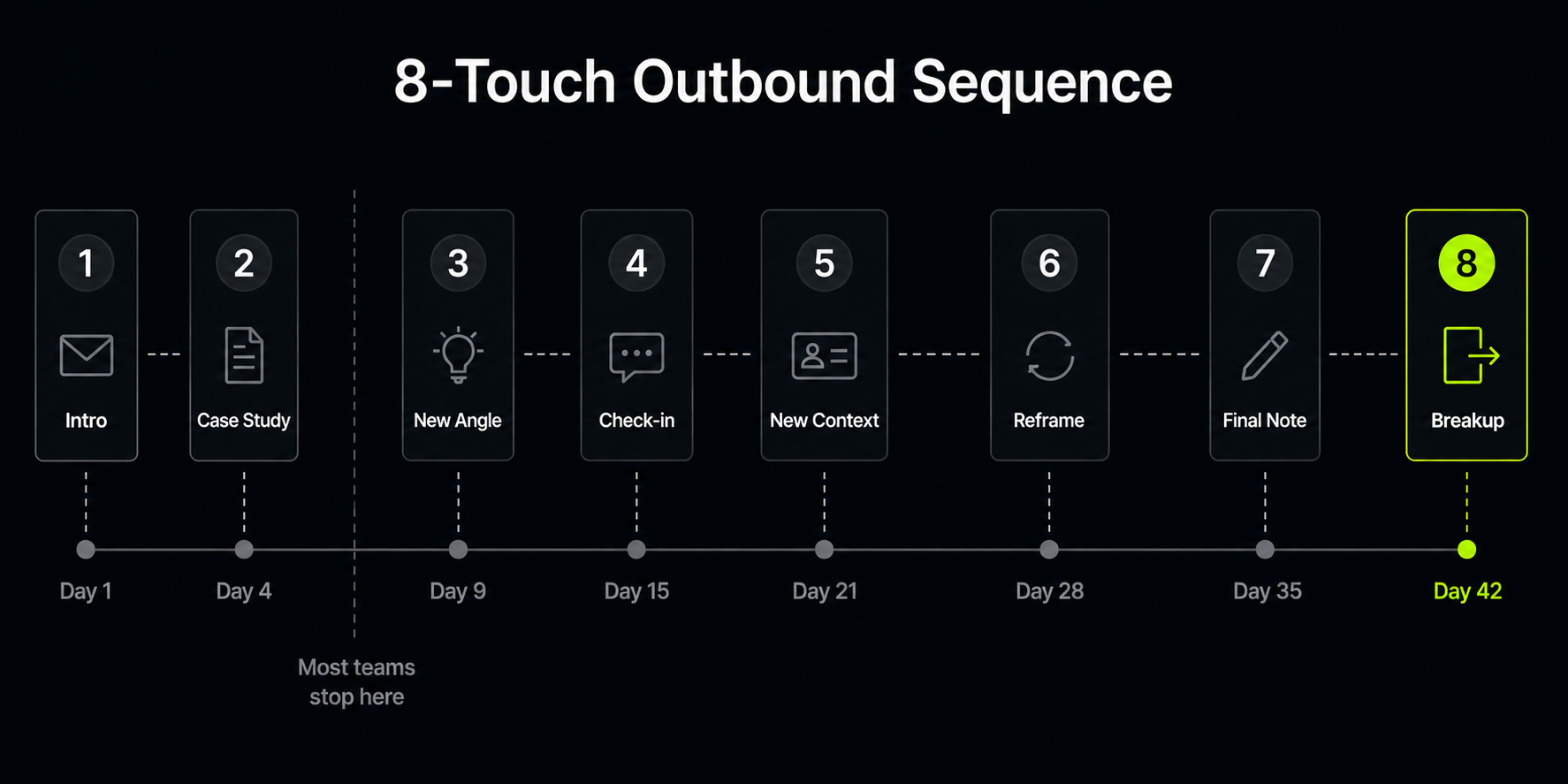
Most teams understand this in principle. In practice, they stop too early. Not because they want to, but because manually managing follow-up across dozens or hundreds of accounts is operationally difficult. Touch one goes out. There is no reply. The rep moves on to something else. The account cycles through without the sequence ever being finished. Sequencing tools exist specifically to close that execution gap.
Multi-touch sequencing is the practice of running a structured series of outreach attempts to a prospect across multiple touches, spaced over time, with distinct angles or value in each touch. The goal is to maintain presence long enough that the outreach lands at a moment when the prospect is ready, not just to send more messages, but to stay in the conversation until timing aligns.
- Most replies arrive after touch four, five, or six, often as late as touch eight. Stopping at one or two means abandoning the majority of the pipeline before the sequence has had a chance to work.
- Each touch needs a new angle. Repeating the same pitch in different words is spam. A sequence where each touch adds something is persistence. The prospect should feel the difference.
- Spacing matters as much as content. Sending five emails in a week reads as automated. Spacing over three to four weeks with genuine variation reads as deliberate follow-through.
- Sequencing tools handle the execution. AI handles the content. The scheduling, spacing, and tracking have been automated for years. What AI adds is the ability to recommend relevant context for each touch based on signals and enrichment data, without the rep doing that research manually.
- The sequence should have a defined end. Not every account will convert. A breakup touch that closes the loop professionally is better than a sequence that trails off into silence.
Why most sequences stop too early
The math on touch volume is not complicated. Reply rates in cold B2B outbound are low on any single touch. Even a well-crafted, signal-grounded first email might convert at 3 to 6% for a reply. That means 94 to 97 out of 100 prospects who would eventually engage do not respond on the first contact. Some are not ready. Some are busy. Some saw the email but did not prioritize responding.
A sequence that stops after one or two touches is making a bet that the small fraction of prospects who reply immediately represents the full opportunity. It does not. The prospect who replies on touch five was not unreachable. They were just not ready when touches one through four arrived. Stopping early does not mean the prospect said no. It means the sequence ran out before the timing could align.
The reason most teams stop early is operational, not strategic. Running a seven or eight-touch sequence manually across a large account list requires someone to track what was sent, when, and what the next step is for every account. Without a system to run that automatically, it collapses under the weight of the list. The rep ends up focusing on the accounts that replied and letting the rest drift.
A sequence that stops after two touches is not a multi-touch sequence. It is two cold emails with a follow-up. The strategy only works if it is actually run to completion.
What each touch is for
A well-built sequence is not a stack of increasingly desperate follow-ups. Each touch has a purpose, and that purpose should be distinct from the touch before it.
Touch one establishes context. It connects a specific signal about the prospect to a specific reason your product is relevant to them. This is the highest-effort touch in the sequence: it carries the most personalization and sets the tone for everything that follows.
Touches two and three build the case. They can introduce a relevant case study, a specific outcome from a company in a similar situation, or a reframing of the problem from a different angle. The goal is to show that you have more to say than the first email conveyed. The outreach was not a one-time blast.
Middle touches maintain presence without pressure. A short, direct check-in that asks a specific question or surfaces a new piece of context. Not "just following up": that phrase adds nothing. A question that shows you have been thinking about their situation.
The final touch, often called the breakup, closes the loop with a direct, low-pressure note that makes it easy for the prospect to respond or disengage. Done well, it often generates more replies than any other touch in the sequence, precisely because it removes the implied pressure and gives the prospect a clean exit that feels respectful of their time.
Spacing: the variable most teams get wrong
The content of each touch matters. But the spacing between touches is equally important and far more often ignored.
Sending five emails in five days is not a sequence. It is a burst, and it reads as automated spam regardless of the copy quality. A prospect who receives daily follow-ups from the same sender in a single week will associate your company with low-quality outreach, which is worse than no outreach at all.
A sequence spaced over three to four weeks with genuine variation in each touch reads as someone who is following up because they actually believe in the relevance of the conversation, not because a system is firing messages on a timer. The spacing itself is a signal of intent. Deliberate gaps communicate that the sender is running a serious sales process, not a spray-and-pray campaign.
A common baseline pattern: touch one on day 1, touch two on day 3 or 4, touch three on day 8 to 10, touches four and five on day 16 to 18 and day 24 to 28. The specific days matter less than the principle: gaps should grow as the sequence progresses, and the final touch should land at a moment when the prospect has had enough time to form a real opinion about whether they want to engage.
What AI changes about this
The execution problem in multi-touch sequencing was solved before AI existed. Sequencing tools like Outreach, Salesloft, and Apollo automated the scheduling, sending, and tracking years ago. The strategy was known: stay present, vary the angle, give it enough touches to work. What remained hard was the content: writing genuinely distinct, relevant copy for each touch, at scale, without it taking the rep's entire day.
Sequencing has evolved through three stages. In the early days, everything was manual: the rep drafted each touch, tracked where every account was in the sequence, and sent each email individually. The middle stage brought sequencing tools: messages were still drafted by a human, but the tool handled scheduling, sending, and tracking automatically. The current stage adds AI to the content layer. The tool still runs the sequence, but AI now recommends context for each touch based on account signals, enrichment data, and instructions the human has defined. The rep sets the strategy and approves the output. The AI handles the research and drafting work that used to sit entirely on the rep.
The result is that teams with a well-built sequence framework can now run it at a scale that would have required a full SDR team five years ago. The leverage is real. But the leverage multiplies whatever is in the sequence: good strategy gets more reach, and weak strategy reaches more people with a weaker message.
A final note: the right sequence length, spacing, and touch count will vary by ICP, deal size, and the nature of your product. The patterns above are common across B2B markets but are starting points, not prescriptions. Teams that calibrate their sequences against reply rate and meeting data over time (adjusting spacing, touch count, and angle mix based on what is actually working) consistently outperform teams that set a sequence once and never revisit it.

Questions on multi-touch sequencing
For most B2B outbound motions, a sequence of 5 to 8 touches over 3 to 5 weeks is a reasonable baseline. The exact number depends on the seniority of your target persona, the length of your typical deal cycle, and the strength of the initial signal triggering the outreach. Senior buyers in complex deals often require more touches and longer spacing. Every touch after the first should add something new (a different angle, a relevant case, a specific question) rather than simply following up on previous silence.
Spacing should be long enough to feel deliberate and short enough to maintain momentum. A common pattern: first touch on day 1, second on day 3 to 4, then progressively longer gaps (day 8 to 10, day 16 to 18, day 24 to 28). Sending multiple emails in quick succession reads as automated. Spacing over weeks with a genuine new angle in each touch reads as persistence. Channel matters too: LinkedIn and phone touches are typically fewer and further apart than email.
The difference between persistence and spam is whether each touch adds something new. A sequence that repeats the same pitch in different words is spam at any length. A sequence where each touch offers a new angle (a relevant case study, a question tied to a specific signal, a different framing of the problem) reads as genuine effort. The prospect should feel that the sender has something worth saying, not that they are working a checklist.
Multi-channel sequences (combining email with LinkedIn, voice messages, or phone) typically outperform single-channel email sequences, particularly for senior personas. The added complexity needs to be worth the coordination cost. For early-stage teams without dedicated SDRs, a well-built email-only sequence with genuine variation often outperforms a multi-channel sequence that is harder to maintain. The channel mix should match the team's capacity to execute it well.
Reply Classification: How AI Handles the Inbox
Interested, not now, wrong person, objection: each requires a different response.
AI Personalization at Scale: Relevance Without the Manual Work
Manual personalization does not scale. Generic templates do not convert. Here is how AI closes that gap.
How to Use AI for Outbound That Actually Converts
8 tactics for using AI across the full outbound workflow, without losing relevance or control.
Building GTM at a B2B startup? I am running a limited number of free 30-minute calls this quarter for founders and first GTM hires who want a second opinion on their outbound setup. No pitch. Just a direct conversation about what you are working with.
Book a Call