When you run outbound at any meaningful scale, replies arrive in volume and variety. Some are warm. Some are objections. Some are "reach out in Q3." Some are referrals to the right person. Some are out-of-office bounces. Without a system to read and route them, the important ones get lost in the noise, or handled with the wrong response.
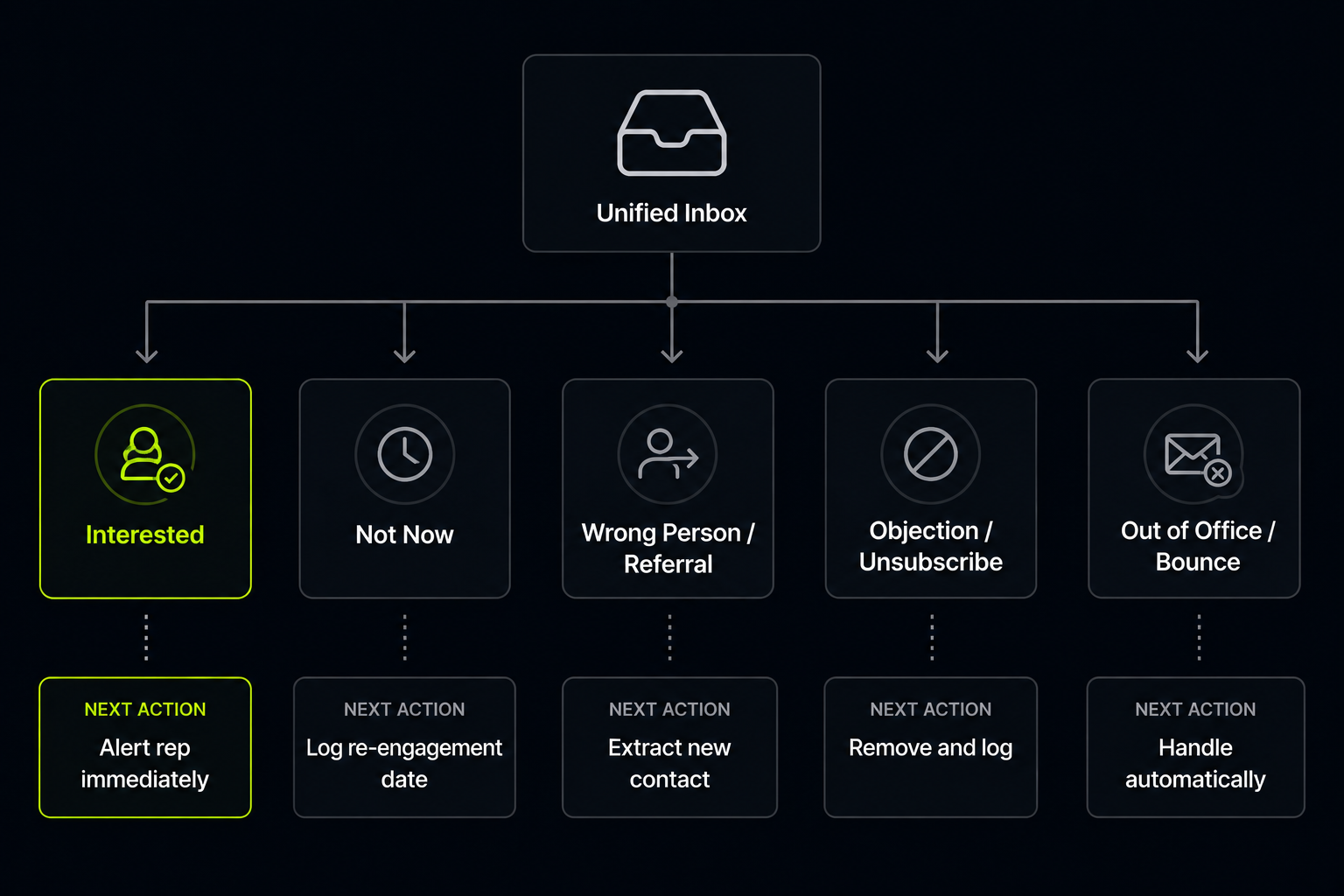
Reply classification is the layer of the outbound system that closes that gap. It reads incoming responses, determines what the prospect actually communicated, and routes the reply to the appropriate next action: alerting a rep, pausing the sequence, logging a future follow-up date, or extracting a referral contact. Done well, it means no reply falls through the cracks and the ones that require human attention get it immediately.
Reply classification is the use of AI to read the content of incoming replies to outbound sequences, determine their intent, and trigger the appropriate next action for each category. The classification is not just a label. It is a routing decision that connects each reply type to a defined workflow outcome.
- Replies come in many forms, and each requires a different response. Treating them all the same, or missing them entirely, is where pipeline leaks.
- The value of classification is in the routing, not the label. Knowing a reply is a "timing objection" only matters if that classification triggers a specific re-engagement workflow.
- Hot replies must go to a human immediately. An interested prospect who receives an automated response instead of a real follow-up will interpret it as talking to a bot, and the opportunity usually closes.
- Referrals are an underused output. A "wrong person" reply that contains a name and department is a warm introduction to the right contact. Most teams ignore it.
- Basic tools pause sequences on any reply. True classification requires intent-reading. The capability exists but is not standard in most outbound stacks.
The reply landscape in outbound
When a prospect replies to a cold outreach sequence, they are communicating one of a small number of things. Understanding the categories matters because each one has a different optimal next action, and handling any of them wrong has a real cost.
Interested or meeting-ready. The prospect wants to talk. This is the reply every sequence is designed to generate. It requires an immediate human response: not an automated acknowledgment, not a templated follow-up, but a real person picking up the thread within hours. The faster the follow-up, the higher the chance the momentum converts to a booked call.
Timing objection. "Reach out in Q3." "We are in the middle of a budget freeze." "Check back after our product launch." These are not rejections. They are instructions. A timing objection handled correctly is a warm re-engagement six months from now. Handled wrong (either ignored or responded to with a generic reply) it becomes a lost prospect who already told you exactly when they would be ready.
Wrong person or referral. "I am not the right contact. You should reach out to [Name] on the RevOps team." This reply contains a warm introduction to the actual decision-maker. Most teams read it, close the email, and never act on the referral. A well-built classification system extracts the referred contact and initiates outreach with the context of where the introduction came from.
Hard objection or unsubscribe. The prospect is not interested and does not want further contact. This requires immediate removal from the sequence and logging, not because of legal requirements alone, but because continuing to contact someone who has explicitly opted out destroys your sender reputation and wastes outreach capacity.
Administrative replies. Out-of-office messages, email bounces, and automatic confirmations. These require no human decision. Just automatic handling that keeps the sequence state accurate.
The inbox is where your outbound investment either pays off or leaks. Classification is the system that ensures every reply gets the action it actually deserves, not the one that was easiest to route.
Why routing is the actual output
A common misunderstanding of reply classification is that the value is in the label. Knowing that a reply is a "timing objection" or a "referral" is only useful if that classification triggers a defined next action. The label without the routing is just a read receipt.
The real output of classification is a set of workflow triggers: interested reply fires an immediate Slack notification to the rep and pauses the sequence; timing objection creates a CRM task for re-engagement on a specific date; referral reply extracts the new contact and adds them to a warm outreach queue; unsubscribe removes the contact and logs the reason. Each classification maps to an action, and the action is what creates value.
Building this routing logic is a one-time investment that pays out on every reply the system processes afterward. The goal is a state where no reply requires a manual triage decision. Every outcome is defined in advance, and the system executes the right action without someone reading each message and deciding what to do next.
The risk of misclassification
The highest-risk failure in reply classification is a false negative on a warm reply: the AI reads an interested response as something else and sends an automated message instead of routing it to a human. This is the scenario that destroys the opportunity entirely.
A prospect who expresses genuine interest and receives a generic automated reply will usually disengage. They feel they are talking to a system, not a person. The trust that the earlier personalized outreach built evaporates in the moment of misclassification. In practice, this means the threshold for routing a reply to a human should be set conservatively. When in doubt, flag it for human review rather than handle it automatically.
The second risk is over-routing: sending everything to a human for review, which defeats the efficiency purpose of the system. The right balance is a tiered approach: anything with any signal of warmth goes to a human; clearly administrative replies are handled automatically; everything ambiguous gets flagged.
What classification enables that manual review cannot
At low volumes, an experienced rep can read every reply and route it appropriately. At higher volumes, running sequences across hundreds of accounts simultaneously, that manual triage does not scale. Replies pile up, prioritization becomes inconsistent, and the timing-sensitive ones (interested replies, referrals) lose the urgency window they require.
Classification makes the volume problem manageable without sacrificing the quality of the response. A rep managing a well-classified inbox is not triaging replies. They are only seeing the ones that need them, at the moment they need a response. The administrative noise is handled. The timing objections are logged. The only replies in their queue are the ones worth their full attention.
This is where the efficiency argument for AI outbound is strongest: not in replacing human judgment, but in ensuring that human judgment is applied only where it is actually required.
A final note: reply classification quality varies significantly across tools and depends on how clearly the routing logic has been defined. Building out the classification categories and their corresponding actions before deploying at scale is what separates a system that works from one that handles the easy cases and misses everything else. The more precisely you define what each reply type requires as a next action, the more reliably the AI can execute it.

Questions on reply classification
AI reply classification is the practice of using AI to read incoming replies to outbound sequences, determine their intent, and route them to the appropriate next action. Rather than having a rep manually triage every reply, the AI categorizes responses (interested, not now, wrong person, objection, referral, out of office) and triggers the corresponding workflow. Hot replies get escalated immediately to a human. Timing-based replies get logged for re-engagement. Administrative replies are handled automatically.
The core categories: interested or meeting-ready (route immediately to a human), not now or timing objection (log with a re-engagement date, remove from active sequence), wrong person or referral (extract the referred contact and initiate outreach), hard objection or unsubscribe (remove and log), and administrative replies like out-of-office or bounce (handle automatically). The classification logic should map to what each category requires as a next action, not just as a label.
The highest-risk failure is misclassifying an interested reply and sending an automated response instead of routing it to a human. A prospect who expresses genuine interest and receives a templated follow-up will often interpret it as talking to a bot, and the opportunity usually closes. The threshold for routing to a human should be conservative: when in doubt, flag it for review rather than handle it automatically.
Basic reply handling (pausing sequences on any reply, flagging out-of-office responses) is standard in most sequencing tools. True intent-based classification, where the AI reads the reply content and routes based on what the prospect actually said, requires more sophisticated tooling. This is an area where purpose-built AI workflow tools have a meaningful advantage over traditional sequencing platforms. The capability is available but is not universally built into standard outbound stacks.
Building GTM at a B2B startup? I am running a limited number of free 30-minute calls this quarter for founders and first GTM hires who want a second opinion on their outbound setup. No pitch. Just a direct conversation about what you are working with.
Book a Call