There is a version of personalization that every sales rep knows does not work: copying someone's LinkedIn headline into the opening line of a cold email. The prospect can tell it is templated. The "personalization" signals effort, but not relevance. And relevance, a genuine reason why this message is worth their time right now, is the only thing that actually moves someone to respond.
This post is about getting personalization to work at scale. The surprise is that you do not get there by personalizing at scale. You get there by scaling personalization.
The two run in opposite directions. Personalization at scale starts with scale: it scrapes a line about each prospect and sprays it across a thousand inboxes. Scaling personalization starts with relevance: it takes the research a good operator does by hand and teaches AI to run that at volume. Same words, opposite outcomes. The order you build in decides whether a message earns a reply or gets deleted.
Which means the work was never the sending. The work is the design: deciding what signal makes a prospect worth contacting, and what a relevant message to that signal actually says. Get that right and AI can run it across a thousand accounts. Get it wrong and AI just scales the mistake.
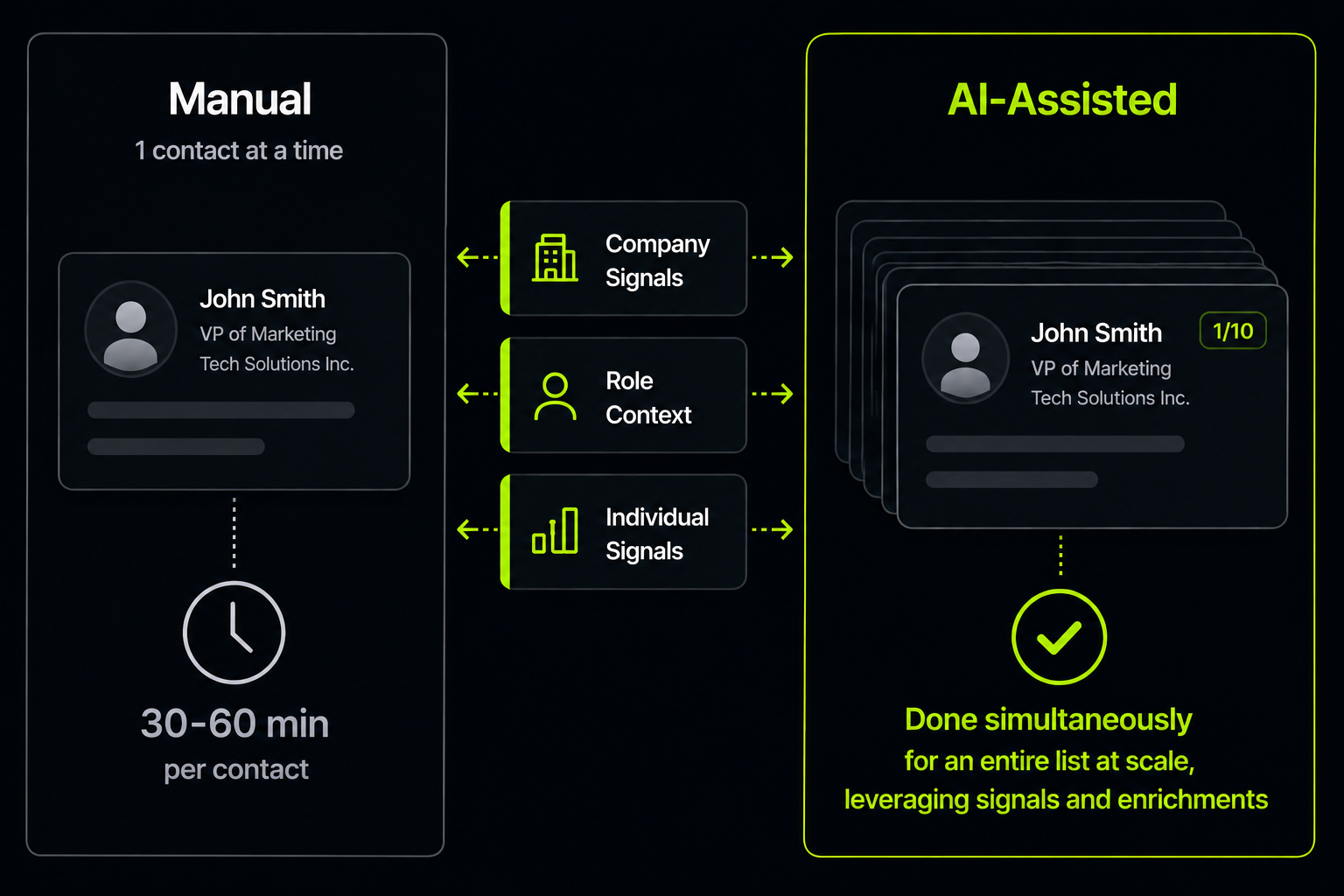
The challenge is that real personalization takes time. Researching each prospect, finding a meaningful signal, and writing a first-touch that connects that signal to a specific reason to care is not a task most teams can run at volume manually. A skilled rep might do it for their top 20 accounts. For a list of 300, it breaks down quickly.
AI-assisted personalization is the answer to that constraint. Not by generating personalization automatically. The inputs still require human judgment, but by dramatically compressing the research and drafting time per prospect once those inputs are defined.
AI personalization at scale is the use of AI to research prospect context from multiple sources and generate or customize outreach messaging in volume, grounded in real signals rather than generic templates. The human defines what signals matter and what the message strategy is. The AI executes that logic across hundreds or thousands of prospects. Built the wrong way, that is just spray with a name attached. Built right, it is scaling personalization: the operator's research, encoded once and run at volume.
- Personalization at scale and scaling personalization are opposite moves. One sprays a scraped line wide. The other takes the research you would do by hand and runs it at volume. Only the second earns replies.
- Personalization only works if it is grounded in a signal the prospect would recognize as relevant. Surface-level references to LinkedIn activity or company name do not move the needle. Relevant triggers do.
- AI makes genuine personalization scalable by handling the research and drafting once you have defined what signals to look for and what message logic to apply.
- The quality of outputs is determined by the quality of inputs. Vague prompts produce generic copy. Specific signal logic and a well-defined message framework produce outreach that reads as intentional.
- Personalization does not have to live in the first line of every email. A message built on the right signal and delivered at the right moment earns relevance throughout, not just in the opener.
- Human review remains essential. AI-generated personalization can produce factual errors, off-tone copy, and misapplied signals. Review before sending to your most important accounts.
The personalization problem in outbound
The average professional receives over 100 emails per day and spends roughly two seconds deciding whether to engage with a cold message. In that window, the question a prospect is answering is not "is this product interesting?" It is: "does this person know something about my situation, or are they guessing?"
A message that leads with a generic opener ("I help companies like yours...") answers that question immediately in the negative. A message that references something specific about the prospect's company, role, or current situation signals that the sender did some work. That does not guarantee a reply, but it earns the two extra seconds needed for the actual value proposition to land.
The cost of doing this manually is significant. Researching a prospect, finding a relevant signal, and writing a message that connects that signal to your product takes 30 to 60 minutes per contact when done properly. At that rate, a rep spending two hours a day on prospecting research can produce meaningful first-touch copy for roughly 50 to 80 accounts per week, before any of the other work they have to do.
The bottleneck in outbound personalization has never been knowing what good looks like. It has been the time it takes to produce it at any meaningful scale.
What AI actually does in this workflow
This is what scaling personalization looks like in practice. The AI's role is not to decide what is relevant to a prospect. That judgment belongs to the human who built the outbound strategy. The AI's role is to execute that judgment at scale: researching each account against a defined set of signals and producing draft copy based on a message framework the human has already approved.
A typical workflow looks like this: the rep or operator defines the signals they care about (recent funding, a new hire in a relevant department, a job posting revealing a specific initiative, a technology change) and writes the message logic for each signal type. What does a message grounded in a funding signal say? What does a message triggered by a new VP of Sales hire look like? Once those templates and logic chains are defined, the AI researches each account, identifies which signal applies, and generates a draft first-touch using the corresponding message logic.
The personalization is not in the first line. It is in the whole message. A prospect who recently closed a Series B and is hiring aggressively into their sales team should receive a message whose entire framing reflects that context, not one that opens with "Congratulations on the funding!" and then pivots to a generic pitch. The signal should inform the angle, the urgency framing, and the specific problem you connect it to.
The three layers of prospect intelligence
Effective AI-assisted personalization draws from three categories of information, and the depth of the output is proportional to how many layers are available.
Company-level signals are the most accessible: funding history, headcount growth, tech stack, recent news, job postings. These tell you what is happening at the organizational level and provide the context for most trigger-based messaging. They are available through enrichment tools, news monitoring, and job board scrapers.
Role-level context narrows the lens to the specific person being contacted. What does their function own? What problems are typical for someone in that role at a company this size and stage? This layer transforms a company-level signal into a person-relevant message. A funding event means something different to a CFO than it does to a Head of Sales.
Individual signals (content the person has published or engaged with, career history, specific public statements) are the highest-value inputs when available, but also the most time-intensive to gather. At scale, AI can surface these signals from LinkedIn and public web data, though the coverage and reliability varies.
Most effective AI personalization workflows operate primarily at the company and role level, with individual signals reserved for top-priority accounts where the extra depth is worth the additional research cost.
Where quality breaks down
The failure mode in AI personalization is not that AI cannot write good copy. It is that AI produces confident-sounding output regardless of whether the underlying input was strong. A vague prompt produces a vague message that reads as generic despite technically containing a prospect's name and company. A well-defined signal with a clear message framework produces outreach that reads as intentional.
The other common failure is using AI to personalize at the surface level: referencing a signal without connecting it to anything meaningful. "I saw that you recently raised a Series B" is not personalization. It is a reference. A scraped line with the prospect's name swapped in is not personalization either. It is a template, and the reader can tell the difference. "You raised a Series B six weeks ago, and most teams at that stage are two quarters away from the point where their current outbound infrastructure breaks under the volume they need" is personalization. The signal earns the connection. The connection earns the response.
This distinction is entirely in the message logic the human defines, not in what the AI produces. The AI executes the logic. If the logic is shallow, the output will be too.
The review layer
AI-generated personalization needs human oversight before it reaches prospects, particularly for high-priority accounts. The review is not about rewriting everything the AI produces. That defeats the purpose. It is about catching the failure modes: factual errors (the AI pulled the wrong signal or misread the context), tone failures (the copy is off-brand or reads as awkward), and misapplied logic (the AI identified a signal and applied the wrong message framework to it).
For broad lists, a sampling review (checking a portion of the AI-generated emails before the sequence sends) is usually sufficient to catch systematic errors without requiring line-by-line approval. For accounts that are high-priority or strategically important, direct review before the first touch is the minimum standard worth maintaining.
A final note: the tools available for AI-assisted personalization have improved significantly and continue to evolve. What the tooling cannot substitute for is the upstream work: a clear ICP, a defined set of signals worth acting on, and a message framework that connects those signals to a reason to care. Teams that invest in that groundwork get dramatically more out of AI personalization than teams that expect the tool to figure it out on its own. The leverage is real, but it does not come from personalizing at scale. It comes from scaling personalization: giving the operator's judgment more reach, not replacing it. The teams that win are not sending more. They are sending the research they always knew they should, now at a scale they could never reach by hand.

Questions on AI personalization at scale
Personalization at scale usually means spraying a lightly customized message wide: a scraped line or a name token attached to an otherwise generic email. Scaling personalization is the opposite move. It takes the research a skilled operator would do by hand, the signal that makes a message relevant to this prospect right now, and uses AI to run that research and drafting at volume. Same words, opposite direction. The first scales effort that looks like personalization. The second scales the relevance that actually earns a reply.
AI personalization in B2B outbound refers to using AI to research prospect context and generate or customize outreach messaging at a scale that would be impossible to achieve manually. Rather than writing a bespoke email for every prospect by hand, AI pulls signals from multiple sources (job postings, news, company activity, LinkedIn data) and uses them to produce contextually relevant first-touch copy. The human defines the message strategy and reviews the output. The AI handles the research and drafting.
Yes, when done well. Personalization built on a relevant trigger (a recent hire, a public announcement, a tech stack change) outperforms both generic templates and performative personalization that references LinkedIn activity without a real point. The lift comes from relevance, not from the appearance of effort. The key is that the signal has to connect to a genuine reason your product is relevant to this prospect right now.
Real personalization connects a specific signal about the prospect to a specific reason your product is relevant to them right now. Fake personalization references something about the prospect without making a meaningful connection to why you are reaching out. A sentence that says "I noticed you recently hired a Head of RevOps, which often means teams are evaluating their data stack" is doing more work than "I saw your great post about revenue operations." One earns the relevance. The other performs it.
At minimum, a human should review AI-generated copy before it reaches your highest-priority accounts. For broader lists, a sampling review process (checking a percentage of AI-generated emails before they send) catches systematic errors without requiring line-by-line approval. The review looks for factual errors, tone failures, and cases where the AI applied the wrong message logic to a signal. Over time, feedback from that process improves the quality of what the AI produces.
Signal-Based Targeting: How to Identify Accounts in Motion
Firmographic filters tell you who fits. Signals tell you who is ready to buy right now.
Waterfall Enrichment: Why One Data Provider Is Never Enough
A single provider covers 40 to 55 percent of your list. Waterfall enrichment reaches 80 to 90 percent coverage.
Multi-Touch Sequencing: Why Persistence Is a Strategy, Not a Tactic
Most replies in B2B outbound come after touch four through eight. Most teams stop at one or two.
Building GTM at a B2B startup? I am running a limited number of free 30-minute calls this quarter for founders and first GTM hires who want a second opinion on their outbound setup. No pitch. Just a direct conversation about what you are working with.
Book a Call