Every B2B sales team filters their target list. Industry, headcount, geography, revenue range. This is necessary work. It defines who belongs in your universe. But it says nothing about when to reach them, and timing is where most outbound either succeeds or wastes itself.
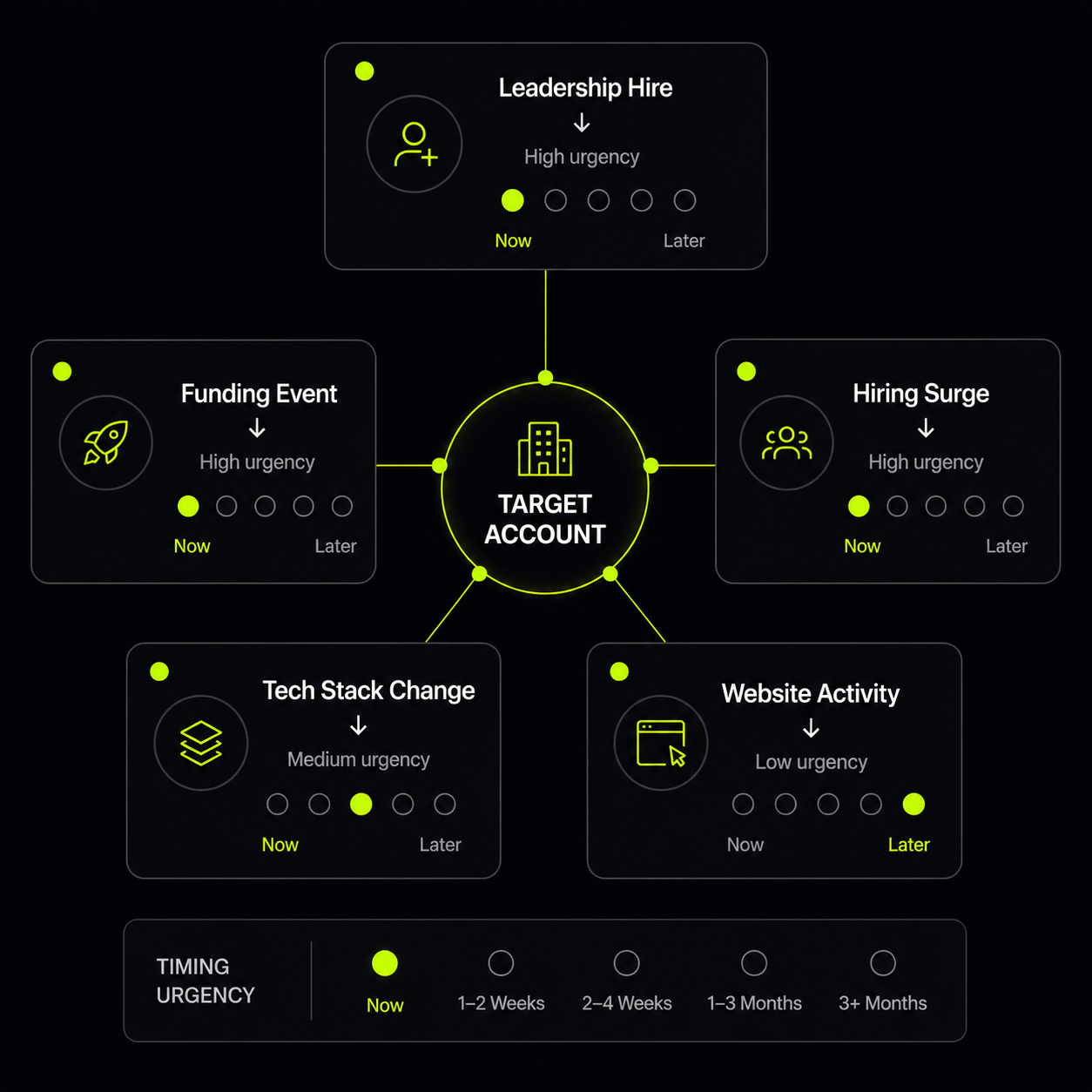
Signal-based targeting adds the missing variable. Instead of asking only "does this company fit?" it asks "is this company in motion right now?" The answer comes from observable events: a recent hire, a funding announcement, a surge in job postings, a shift in tech stack. These signals indicate that something is changing inside the company, and change is when buying decisions get made.
Signal-based targeting is the practice of using observable behavioral and organizational events to identify when an ICP-fit account is likely in an active evaluation or buying position, and prioritizing outreach accordingly.
- Filters define who fits. Signals define who is ready. Both are necessary, but timing is the variable most teams ignore.
- Signal-based outreach consistently outperforms volume outbound on reply rates, meeting quality, and cost per opportunity.
- The highest-value signals are tied to organizational change: leadership hires, funding events, hiring surges, and tech stack shifts.
- Combining multiple signals on the same account dramatically increases targeting confidence. A single signal is a possibility. Two or three is a strong indicator.
- The window after most signals is narrow. Acting within weeks of a trigger event is often what separates a reply from being ignored.
- The signal itself is becoming commodity. Every tool surfaces the same events. The edge is the second layer: reading what an event means, not just catching that it fired.
- These are guidelines, not rules. Signal relevance varies by industry and product. Adapt the approach to your specific market.
Why volume outbound has a ceiling
Volume-based outbound is built on a simple premise: reach more people and more of them will respond. This works up to a point. But the ceiling is lower than most teams expect, and the costs above it are high.
When outreach is not anchored to a reason for the prospect to care right now, the message competes with everything else in their inbox on equal footing. There is no timing advantage. There is no signal the rep can reference to demonstrate relevance. The prospect has no particular reason to respond this week versus never.
The result is a reply rate ceiling that even excellent copy struggles to break through. Volume-based cold outreach typically achieves 1-3% reply rates. Apollo's benchmarking data puts well-run, signal-triggered outreach at 4-8%, with top programs exceeding that. The difference is not in the message. It is in the timing of the reachout.
The bottleneck in outbound has never been reach. It has been relevance at the right moment. Signals solve the timing problem that filters cannot.
The signals worth acting on
Leadership change in the relevant department. A new Head of Sales, VP of Marketing, or equivalent hire in the team that uses your product is one of the highest-converting signals available. New leaders have budget authority, something to prove, and are actively evaluating how the team operates. Research suggests that new executives allocate a significant share of their early budget in the first 90 to 100 days. The window is real and it closes.
Funding events. A recently closed funding round means new budget, new mandates, and new pressure to build something that works. Industry data indicates that the majority of recently funded companies finalize key vendor decisions within 90 days of the announcement. Reaching them within the first month or two, once the round has turned into a hiring plan and a budget, puts you ahead of the evaluation curve. The week of the announcement itself is the noisiest moment to arrive, when every other vendor is reaching out and the company has the least clarity on how the money will be spent.
Hiring velocity in the relevant department. A company adding headcount rapidly in the team you sell to is scaling a function that will need tools and infrastructure to support it. Static headcount tells you size. Growth rate tells you direction and urgency.
Job postings that reveal a new initiative. A company posting for a Head of Revenue Operations for the first time, or three BDR roles after having none, is revealing a strategic decision. These postings are public signals of internal intent, and they carry timing information that firmographic filters never could.
Technology stack changes. Adding or removing a tool in a category adjacent to yours indicates that a team is actively evaluating their infrastructure. Companies that have recently adopted a complementary tool, or churned from a competitor, are in a window of evaluation that makes them more receptive to adjacent conversations.
These are general signals that apply across most B2B markets. The higher-leverage work is identifying signals specific to your ICP. A new regulation taking effect in a target industry. A compliance deadline approaching. A major platform deprecation that forces infrastructure changes. The teams that win at signal-based outreach are the ones who go beyond the standard playbook and find the signals their competitors are not watching.
The second layer: reading the signal, not just catching it
Detecting a signal is now the easy part. Every signal intelligence tool surfaces the same funding rounds, the same leadership hires, the same job postings, and routes them to every team watching the same accounts. When catching the signal is commodity, it stops being the advantage. The advantage moves to the read underneath it.
Take a job posting. A company posting a Head of Revenue Operations is an event every tool will flag. But a role that has sat open for four months is a different signal entirely. The opening is not the information. The fact that they cannot close it is. The work is not getting done, and the pain is acute. Same posting, a deeper read, a sharper reason to reach out.
The same posting holds more that most teams skip. A job description listing a competitor's tool as required tells you the account is already committed elsewhere. That is not necessarily a reason to walk away. It is a reason to change the message: you are now a displacement conversation with the incumbent named, not a cold pitch into the unknown.
Funding shows the same gap between the event and its meaning. The instinct on a funding announcement is to reach out the day it breaks. That is the day every other vendor reaches out too, and the day the company has the least clarity on how the new money will be spent. The sharper window opens a little later, once the round has become a hiring plan and a budget. Early still wins. The first week is mostly noise.
The principle generalizes. The surface of a signal tells you something happened. The second layer tells you what it means, and the meaning is where the relevance lives. Tools deliver the surface to everyone equally. The read underneath is still the operator's work.
Signal stacking: when confidence gets high enough to act
A single signal can be valuable on its own. Multiple signals on the same account at the same time is a strong indicator of buying readiness and warrants immediate prioritization.
Consider the difference between these two accounts in your pipeline:
Account A: Fits your ICP criteria. No recent signals.
Account B: Fits your ICP criteria. Closed a Series B three weeks ago. Hired a new VP in the department that uses your product last month. Has posted four BDR roles in the past 60 days.
Account B is not just a fit, it is a company in active motion. Signal stacking is the practice of combining multiple signals on the same account to build a high-confidence picture of buying readiness. Each signal alone is a data point. Together they form a case for immediate outreach with a specific angle.
The message to Account B does not say "I noticed your company might benefit from..." It says something grounded in what you actually know: that they are building out their team, recently funded, and in a position where the problem you solve is becoming urgent. That is not personalization for its own sake. It is relevance earned by paying attention.
The timing window
Most signals have a window after which their value as a trigger diminishes. A funding announcement from 8 months ago is no longer a timing signal. A VP hire from last week is. Acting quickly after detecting a high-priority signal is not just good practice. In competitive markets, it is often the difference between being part of the evaluation and arriving after it has closed.
Research on B2B buying behavior consistently shows that the first vendor contacted has a significant advantage in winning the deal. Being early to a signal means being early to the conversation, before the prospect has formed strong preferences and before competitors have had time to position.
This does not mean sending the same message the day a signal is detected. It means having a workflow that surfaces signals quickly, prioritizes them appropriately, and ensures outreach happens within a defined window rather than sitting in a queue for weeks.
What changes in practice
Signal-based targeting does not replace ICP filters. It operates on top of them. The filter defines who belongs in your universe. The signal defines who in that universe deserves your attention this week.
The practical shift is in how you build and prioritize your outbound list. Instead of pulling a filtered list and working through it top to bottom, you monitor your target accounts for signals and let those events drive sequencing and prioritization. Accounts with active signals move to the front. Accounts without signals sit in a monitoring queue until something changes.
This approach requires more setup than a one-time list export. But it produces a working pipeline that is self-updating: as signals appear, accounts surface. As windows close, accounts cycle back to monitoring. The list is never stale because it is built on what is happening now, not what was exported last quarter.
A final note: the signals that matter most will vary by industry, product, and deal cycle. The examples above are common across B2B markets, but the highest-value signals for your specific business may be different. The principle is simple: act on change, not just on fit. It applies universally. The specific signals worth monitoring should be calibrated to your own closed-won data over time.

Questions on signal-based targeting
Signal-based targeting uses observable behavioral and firmographic events to identify when a company is likely in an active buying position. Rather than building lists from static filters alone, you layer in signals like hiring activity, funding events, leadership changes, and tech stack shifts to reach the right accounts at the right moment. The goal is timing precision, not just fit.
The highest-impact signals tend to be tied to organizational change: a new executive hire in the relevant department, a recent funding round, or a significant hiring surge in the team you sell to. These indicate budget availability and openness to change. Job postings revealing a new initiative and technology stack changes showing active evaluation are also strong. The most effective approach combines multiple signals for a single account, which dramatically increases confidence.
For time-sensitive signals like a new executive hire or a funding announcement, the window is typically 30 to 60 days. Research suggests that the majority of recently funded companies finalize key vendor decisions within 90 days of the announcement, and new executives allocate a significant share of their early budget in the first 100 days. Acting within a few weeks of the signal gives you first-mover advantage.
No. Many of the most useful signals are available through tools you may already have: LinkedIn for job postings and hiring patterns, Crunchbase for funding events, and simple web monitoring for company announcements. Dedicated signal intelligence platforms add coverage and automation at scale, but the principle works at any budget. The mindset shift matters more than the tooling: stop building lists from filters alone and start asking what has changed at this account recently.
When every signal tool surfaces the same funding rounds, leadership changes, and job postings, catching the signal is no longer an advantage. The advantage is in the second layer: reading what the event actually means. A role left open for four months signals acute pain, not just hiring. A job description that requires a competitor's tool turns a cold pitch into a displacement conversation with the incumbent named. Reading a funding round for timing tells you the announcement week is the noisiest moment to reach out, not the best. The data is commodity. The interpretation is where relevance and reply rates are won.
Account Scoring Done Right
Custom signals beat basic filters. How to build a scoring model that surfaces accounts most likely to convert.
How to Use AI for Outbound That Actually Converts
8 specific ways to use AI across the full outbound workflow without losing relevance or control.
AI Has Not Changed What Works in Sales. It Accelerated It.
The AI SDR replacement thesis largely failed. Here is what actually works in B2B outbound in 2026.
The Full GTM Cycle: Best AI-Native Tools for Each Stage
A stage-by-stage breakdown of the best AI-native tools for each part of the outbound cycle.
Waterfall Enrichment: Why One Data Provider Is Never Enough
A single provider covers 40 to 55 percent of your list. Waterfall enrichment reaches 80 to 90 percent coverage.
AI Personalization at Scale: Relevance Without the Manual Work
Manual personalization does not scale. Generic templates do not convert. Here is how AI closes that gap.
Building GTM at a B2B startup? I am running a limited number of free 30-minute calls this quarter for founders and first GTM hires who want a second opinion on their outbound setup. No pitch. Just a direct conversation about what you are working with.
Book a Call