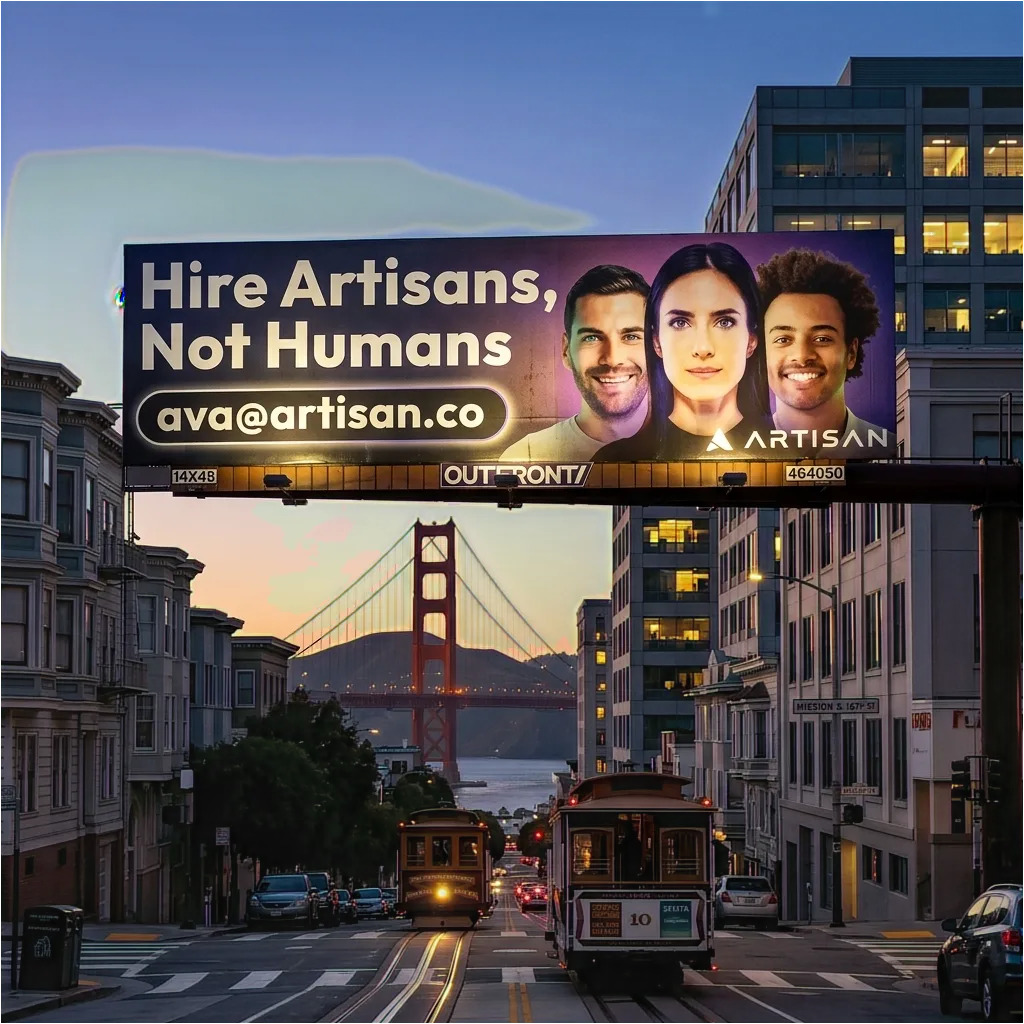
In 2024, one of the biggest players in the AI sales market ran a billboard campaign with a simple message: stop hiring humans. It made headlines, sparked debate, and raised a lot of money.
By 2025, the company was dealing with canceled contracts, collapsing reply rates, and a reputation problem it had not anticipated. The billboards were still up. The thesis was not.
AI outbound is the use of artificial intelligence tools to automate and accelerate list building, personalization, and sequencing in B2B sales. The promise was that it would replace the human sales development function. The reality is more nuanced.
- The AI SDR replacement thesis failed. Cancellation rates for managed AI SDR programs ran 50-70% inside 90 days. Deliverability collapsed, reply rates cratered, and cost per meeting went up.
- Volume was never the bottleneck. What limits B2B outbound has always been targeting precision, message relevance, timing, and persistence. AI did not change any of that.
- AI accelerates four things well: building targeted lists, surfacing relevance signals at scale, running intelligent multi-touch sequences, and keeping list data clean.
- The winning model is a power multiplier, not a replacement. One skilled operator using AI to work at the scale of a team, with a human review loop before anything reaches a prospect.
- The fundamentals still decide outcomes. A fuzzy ICP, a message that leads with your product, or giving up after one or two touches will still kill results, just faster.
What went wrong was not the AI. It was the assumption underneath the pitch: that volume was the bottleneck in B2B sales, and that if you could automate volume, you would automate revenue. It is a logical-sounding argument. It is also wrong.
The bottleneck in B2B sales has never been volume. It has always been the same four things: reaching the right person, with a message that is actually relevant to them, at a moment when they have a reason to care, and staying in the conversation long enough for the timing to align. AI did not change any of that. It just made it faster to do right, and much faster to do wrong.
The moment the math broke
Google's bulk-sender policy update in February 2024 made this impossible to ignore. When spam complaint rates cross 0.3 percent and volume spikes trigger pattern detection, inbox placement collapses. For AI-driven programs running thousands of sends per day across multiple mailbox aliases, that threshold arrived fast. Reply rates that might have sat at 4 to 6 percent from a warmed human sender dropped to under 2 percent. Cost per meeting went up, not down. The economic case that justified "stop hiring humans" fell apart at the infrastructure level, before the conversation even started.
But the infrastructure was a symptom. The deeper problem was that most teams using AI outbound had not done the work that tools cannot do for you.
The fundamentals have not moved
Every deal that closes in B2B outbound traces back to the same pattern. Someone had a precise picture of who they were going after. They said something that made the prospect feel like they had done their homework. And they showed up at the right moment, or they stayed present long enough to be there when the moment came.
That is the whole game.
What kills outbound is not a bad tool. It is a fuzzy ICP. It is a message that leads with your product instead of their problem. It is giving up after one or two touches because the sequence ran out. These are not AI problems. They are judgment problems. They existed before Clay and Apollo. They will exist after whatever comes next.
The teams I have seen win with AI outbound are the ones who understood this early. They did not ask "how do I use AI to send more?" They asked "how do I use AI to get sharper?"
The teams winning right now did not go all-in on automation. They got precise about who they were going after and why, then used AI to execute that work at scale.
What AI actually accelerates
Targeting precision. Building a high-quality list used to mean days of manual research: exporting from LinkedIn, cross-referencing funding data, filtering by headcount and tech stack, cleaning duplicates. A skilled operator can now do in an hour what took a week. AI does not make targeting decisions for you. It removes the friction between knowing who you want to reach and having them in front of you.
Relevance signals. Finding the trigger that makes a message worth sending (the recent hire, the funding announcement, the product launch, the job post signaling a new initiative) used to take time that most SDRs did not have. AI tools can surface these signals at list scale. The result is not automated personalization. It is informed personalization. The message still has to be written by someone who understands what the signal means and why it matters to the prospect.
Sequence management. Most replies in outbound come on touch four, five, six, or even eight (depending on industry and the seniority of the persona you are targeting). Most teams stop at one or two. AI-assisted sequencing makes it practical to run intelligent multi-touch follow-up without a full SDR team managing it manually. The fundamentals (timing, spacing, tone) still apply. AI runs them consistently.
List hygiene. Bad data kills deliverability before a single message lands. AI-assisted enrichment and validation, verifying emails, flagging role changes, identifying stale contacts, keeps bounce rates low and domain reputation intact. Unglamorous work, but it is what keeps the system running.
The human in the loop
Think about how often AI gets things wrong in your own daily use. It misreads the prompt. It fills in gaps with confident-sounding nonsense. It does something adjacent to what you asked and presents it as done.
Now imagine that running at scale, unsupervised, into the inboxes of your best prospects.
The "set it and let it run" version of AI outbound is still not reliable enough to trust without oversight. The teams that learned this the hard way in 2024 found out through burned domains and dead reply rates. The winning model is not AI replacing the operator. It is one skilled operator, empowered by AI, working like a team of five.
That is the actual unlock. Not dull automation. Not "stop hiring humans." A sharp human in the loop who checks the output, guides the inputs, catches the errors before they hit the prospect, and uses AI to compress what used to take a week into a morning. One person working at a scale that was not possible two years ago.
That is what a power multiplier looks like. It still needs someone holding it.
What does not change
None of this works if the ICP is wrong. If you are targeting companies that do not have the problem you solve, or the wrong persona within the right company, volume makes it worse. You find out faster that your assumptions are off, and you burn more domain health in the process.
None of this works if the message is about you. "We help companies like yours increase revenue by 40%" is not a message, it is a placeholder. The prospect reads it and hears noise. AI can generate that placeholder at infinite scale. It takes human judgment to write something that makes a specific person feel seen.
The billboard said stop hiring humans. What the market said back was: the humans were never the problem.
AI did not change what works in sales. It accelerated it, in both directions. Get the fundamentals right and AI gives you real leverage. Get them wrong and you will discover that faster, and at greater cost.

Questions on AI and B2B outbound
No. The AI SDR replacement thesis that gained traction in 2024 largely failed. Cancellation rates for managed AI SDR programs ran at 50 to 70 percent inside 90 days, driven by deliverability collapse and a fundamental misunderstanding of what limits B2B pipeline. The bottleneck was never send volume. AI accelerates the four fundamentals of outbound when a skilled operator is driving. It does not replace them.
Four things have always decided B2B outbound outcomes: reaching the right person at the right company, delivering a message genuinely relevant to their situation, timing that message to a moment when they have a reason to care, and staying in the conversation long enough for that timing to arrive. AI can accelerate each of these when a skilled operator is directing it. It cannot substitute for the judgment behind them.
Use AI as a power multiplier, not a replacement. AI handles research, list building, data enrichment, signal identification, and sequence management well. Humans should own initial outreach, message framing, and anything that requires judgment about what a signal means for a specific prospect. The winning model is one skilled operator using AI to work at the scale of a team, with a review loop before anything reaches the prospect.
Fractional CMOs bring strategy and deliver documents. GTM engineers build what you tell them to build. The GTM Lab brings the strategic judgment to define what needs to be built, then builds it, configures it, launches it, and hands it over ready to run. Strategy is part of the work, not the output.
Account Scoring Done Right
Custom signals beat basic filters. How to build a scoring model that surfaces accounts most likely to convert.
Signal-Based Targeting: How to Identify Accounts in Motion
Firmographic filters tell you who fits. Signals tell you who is ready to buy right now.
How to Use AI for Outbound That Actually Converts
8 specific ways to use AI across the full outbound workflow without losing relevance or control.
The Full GTM Cycle: Best AI-Native Tools for Each Stage
A stage-by-stage breakdown of the best AI-native tools for each part of the outbound cycle.
Building GTM at a B2B startup? I am running a limited number of free 30-minute calls this quarter for founders and first GTM hires who want a second opinion on their outbound setup. No pitch. Just a direct conversation about what you are working with.
Book a free call