There is a version of account scoring that most teams do: filter by industry, headcount, and geography, sort by company size, and call it a prioritized list. It is not scoring. It is sorting. And the distinction matters more than most teams realize.
Real account scoring answers a different question. Not "does this company fit our ICP on paper" but "is this company worth reaching this week." The first question filters your universe. The second question drives your pipeline. Most teams stop at the first.
Account scoring is a systematic method for ranking accounts by their likelihood to convert, based on a combination of fit criteria and behavioral signals. Done well, it tells your outbound team who to prioritize and why, not just who belongs in the universe.
- Filtering is not scoring. Firmographic filters define who could be a fit. Scoring tells you who in that group is worth reaching right now.
- Behavioral signals outperform static attributes because they indicate timing, not just fit. Job postings, headcount growth, and funding events are more predictive than company size or industry alone.
- The best scoring inputs come from your own data. Your closed-won deals are the most reliable source of ICP signal you have. Most teams do not mine them.
- A strong offer and genuine product-market fit come before any scoring tactic. Precise targeting cannot fix a bad offer. It just finds the rejection faster.
- Start simple and iterate. A three-tier model built on four to six signals beats a complex formula built on assumptions. Refine as you close deals.
- These are guidelines, not rules. The signals, weights, and timing windows that work best will vary by industry, deal cycle, and product. Adapt the framework to your specific market.
Why basic filters underperform
Two companies can look identical on a filtered list. Same industry. Same headcount range. Same geography. Same technology stack. One is two weeks away from launching an initiative that your product directly enables. The other just signed a three-year contract with your top competitor.
A firmographic filter cannot tell the difference. A scoring model that incorporates behavioral signals can.
The practical consequence is that teams relying on filters alone spread outreach effort evenly across accounts that are in wildly different buying positions. Some of those accounts will never be reachable no matter how good the message is. Others are ready to move and you reach them at the wrong moment because nothing prioritized them above the noise.
Account scoring is the mechanism that introduces timing into targeting. It does not replace ICP criteria. It operates on top of them.
The signals that actually predict conversion
Static firmographic attributes (industry, headcount, revenue range) are necessary for defining the universe but poor predictors of conversion on their own. The signals that correlate with real buying intent are almost always behavioral.
Job postings. A company actively hiring for a role adjacent to your product is revealing an initiative in motion. If you sell sales infrastructure and a company posts three BDR roles in 60 days, they are building an outbound motion. That is a signal with a timing window. It does not last forever.
Headcount growth. A team that has grown 40 percent in six months in the department you sell to is scaling a function that will need tools to support it. Static headcount tells you size. Growth rate tells you direction.
Funding events. A Series A or B close is a predictable buying trigger. New budget, new mandates, new pressure to build something that works. The window is typically 30 to 90 days after the announcement.
Technology stack changes. Adding or removing a tool in a category adjacent to yours signals that a team is actively evaluating their stack. This is available via enrichment data and is more predictive than most teams realize.
Website behavior. A company whose employees are repeatedly visiting your site, especially pricing or comparison pages, is evaluating you. De-anonymized visitor data turns passive interest into an active signal.
Leadership change in the relevant department. A new head or VP in the department that uses your product is one of the highest-converting signals available. New leaders have something to prove, often control budget, and are actively evaluating how the team operates. The first 60 to 90 days is the highest-receptivity window, but it is not the only one.
Static attributes tell you who fits. Behavioral signals tell you who is in motion. Scoring without signals is just sorting with extra steps.
Building from your own won/loss data
Generic scoring frameworks, industry templates, benchmark ICPs, third-party models built on aggregate data, are a starting point at best. The most reliable scoring inputs are specific to your product, your market, and your actual deal history.
Your closed-won deals are the signal. What did the companies that converted have in common that your losses did not? What was the headcount range, the funding stage, the tech stack, the team structure? What signals were present in the 30 to 60 days before they entered the pipeline? What did the loss reasons reveal about who was a bad fit even when they looked right on paper?
Most teams do not systematically mine this data. It sits in CRM notes, in memory, in occasional deal reviews. Pulling it out and turning it into scoring criteria is one of the highest-leverage things a sales or revenue ops leader can do, and it compounds. Every deal adds signal. The model improves over time in a way that generic frameworks cannot.
One thing most teams miss: not all shared attributes are scoring signals. If a criterion appears equally across your wins and your losses, it is not predictive of conversion. It may still be useful as a filtering attribute to define who belongs in the universe, but it should not carry weight in the score. The signals worth prioritizing are the ones that appear disproportionately in won deals and are largely absent from lost ones.
At seed stage and even in Series A, you may not have enough closed deals to make this statistically meaningful. Score on signals in the interim and start documenting patterns from day one. The data is accumulating whether or not you are capturing it.
What a functional scoring model looks like
A scoring model does not need to be complicated to be effective. The goal is consistent prioritization, not a perfect formula. A simple model that the team actually uses beats a sophisticated one that lives in a spreadsheet no one trusts.
A practical starting point for early-stage B2B companies:
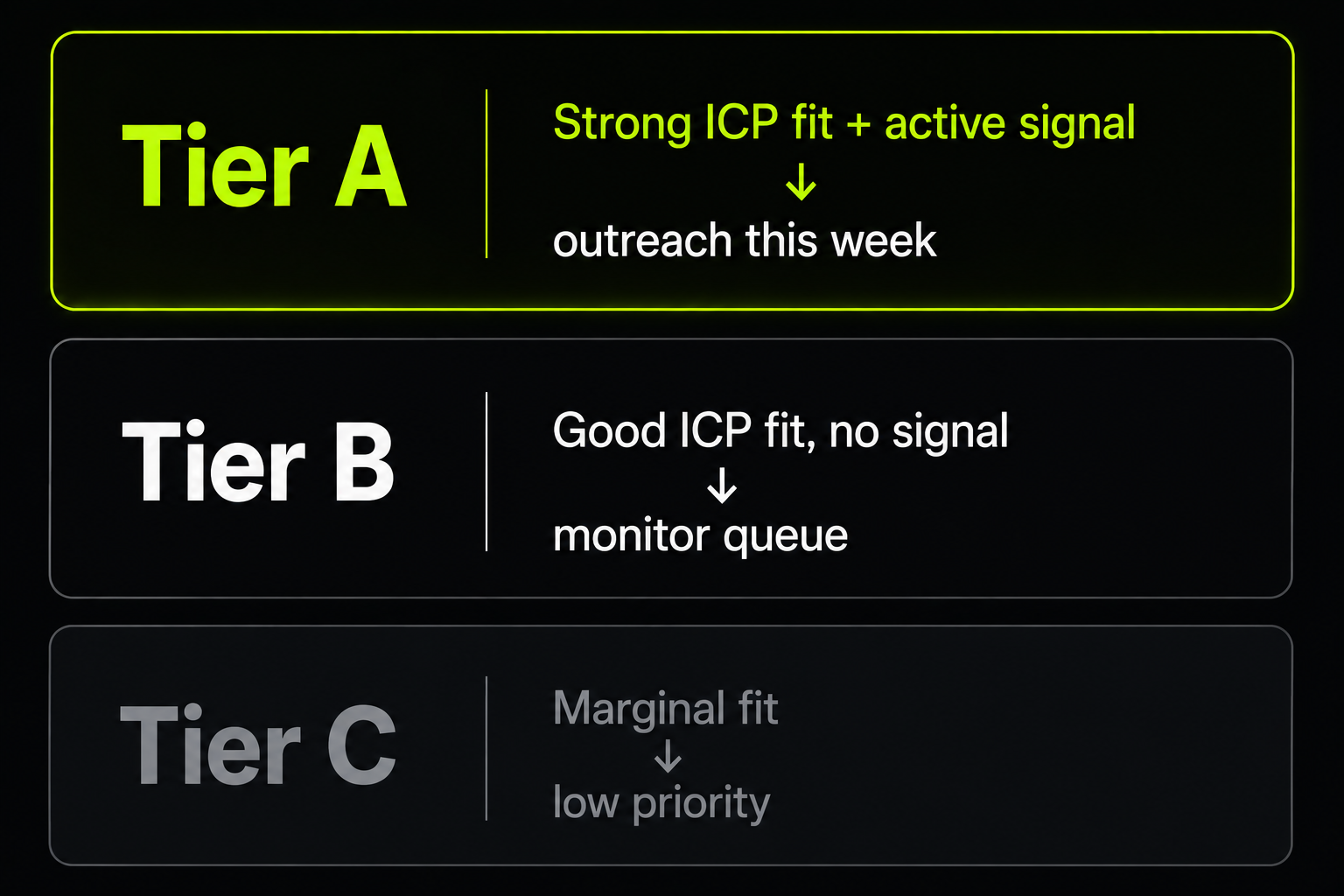
Tier A: Strong fit on core ICP criteria plus at least one active behavioral signal. These accounts get outreach this week. Personalization uses the specific signal as the anchor.
Tier B: Good ICP fit, no active signal currently. These accounts go into a monitoring queue. When a signal appears, they move to Tier A automatically.
Tier C: Marginal ICP fit or signals that are weak or ambiguous. These are low-priority unless volume demands it.
The tier structure is less important than the underlying logic: ICP fit determines eligibility, signals determine timing. That combination is what separates a prioritized pipeline from a sorted list.
The offer still comes first
A strong scoring model will find the right accounts faster. It will not fix a weak offer or a message that does not resonate. Precise targeting accelerates feedback in both directions: it gets your best prospects in front of you faster, and it reveals that your offer is not working before you have burned through your entire addressable market.
Teams that over-invest in scoring mechanics before validating that their core offer works tend to interpret low reply rates as a targeting problem. Sometimes it is. Often it is a message problem, or an offer problem, that more precise targeting is simply exposing more efficiently.
Get the fundamentals right first: a specific ICP, a message that leads with the prospect's problem rather than your product, and a reason for them to care right now. Scoring amplifies what is already working. It does not create leverage from nothing.
A final note: everything in this post is a general framework. The signals that matter most, the scoring weights that drive prioritization, and the timing windows that apply will vary by industry, deal cycle length, and product category. Use these as a starting point, not a prescription. The teams that get the most out of account scoring are the ones that adapt the model to their specific market rather than applying it as written.

Questions on account scoring
ICP filters define who could be a fit: industry, headcount, geography, revenue range. Account scoring tells you who in that universe is worth prioritizing right now, based on behavioral signals and custom criteria derived from your own data. Filters define the universe. Scoring drives prioritization within it.
Start with signals that indicate a company is in motion: relevant job postings, headcount growth in the departments you sell to, recent funding events, and technology stack changes. These outperform static firmographic attributes because they indicate timing, not just fit. The best signals are the ones that correlate with your own closed-won deals, which is why building from your own data is more reliable than using generic scoring criteria.
Score on signals, not a statistical model. Use behavioral signals (job postings, headcount changes, funding events) to surface accounts that are in motion, even before you have enough closed deals to build a data-driven ICP model. As you close deals, document what the winning accounts had in common: what signals were present, what the timing looked like, what the loss reasons revealed. Feed that pattern back into your scoring criteria. The model improves with every deal.
Clay is the most flexible option at seed and Series A, you can build custom scoring columns using job posting data, headcount changes, funding signals, and website copy without needing a developer. Apollo works well as a starting point for filter-based targeting before you graduate to signal-based scoring. Keyplay is purpose-built for ICP scoring and becomes particularly powerful at Series A once you have 25 or more closed deals to build the model from.
AI Has Not Changed What Works in Sales. It Accelerated It.
The AI SDR replacement thesis largely failed. Here is what actually works in B2B outbound in 2026.
How to Use AI for Outbound That Actually Converts
8 specific ways to use AI across the full outbound workflow without losing relevance or control.
The Full GTM Cycle: Best AI-Native Tools for Each Stage
A stage-by-stage breakdown of the best AI-native tools for each part of the outbound cycle.
Signal-Based Targeting: How to Identify Accounts in Motion
Firmographic filters tell you who fits. Signals tell you who is ready to buy right now.
Waterfall Enrichment: Why One Data Provider Is Never Enough
A single provider covers 40 to 55 percent of your list. Waterfall enrichment reaches 80 to 90 percent coverage.
Building GTM at a B2B startup? I am running a limited number of free 30-minute calls this quarter for founders and first GTM hires who want a second opinion on their outbound setup. No pitch. Just a direct conversation about what you are working with.
Book a Call