Your website already has intent data in it. Every company visiting your pricing page, your product tour, or your case studies is showing some level of interest. Most B2B teams collect none of it. Without a form submission, the visit disappears into anonymized Google Analytics numbers. Website visitor identification exists to change that.
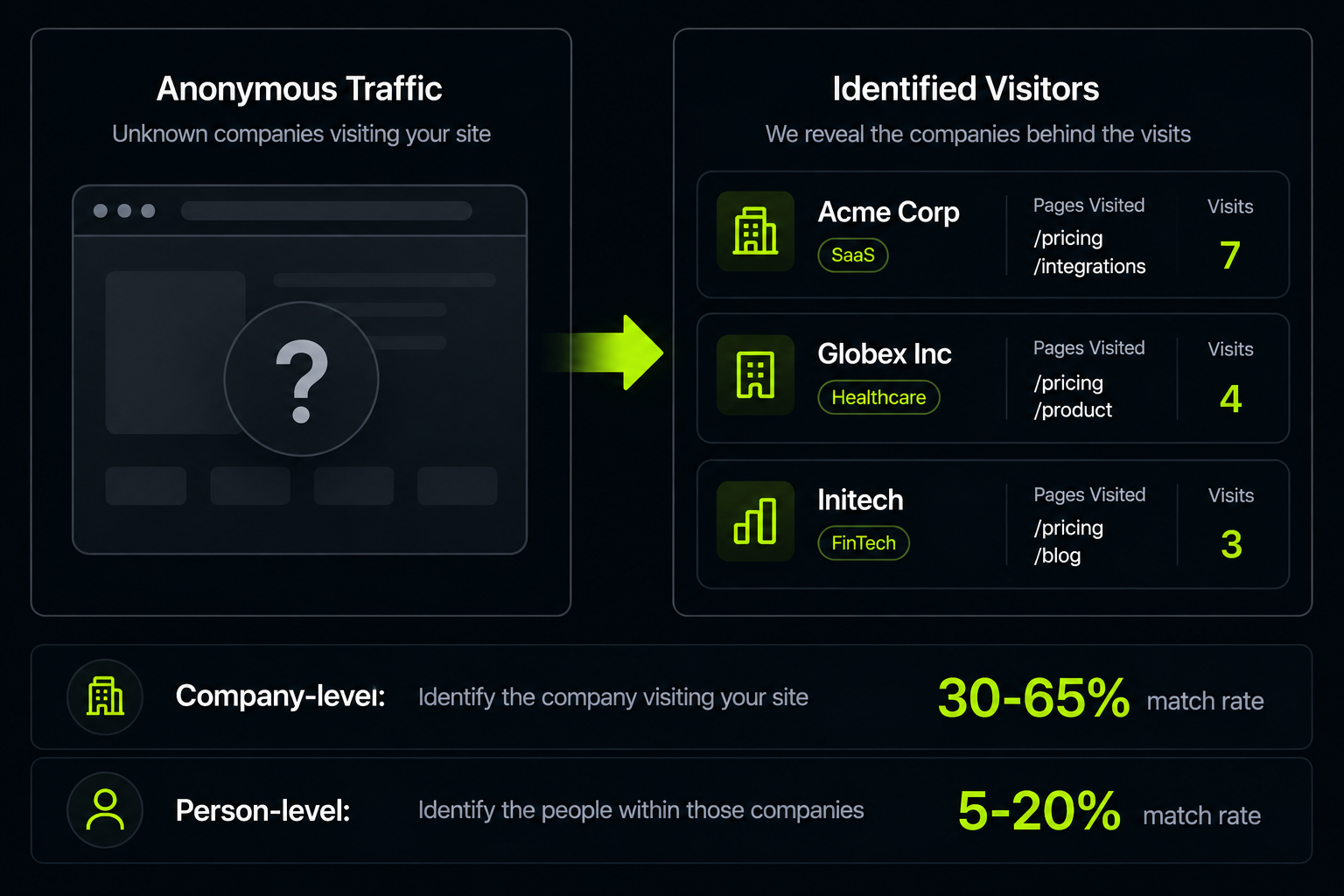
The premise is straightforward: a visitor lands on your site, your tracking pixel fires, and in the background, identity resolution technology attempts to match that visitor to a company or, in some cases, an individual. The match goes into a feed your sales team can act on. The visit that would have been invisible becomes a signal you can route into your outbound workflow.
Website visitor identification is the use of tracking technology and identity graph data to reveal which companies (and sometimes which individuals) visiting your website without completing a form. Company-level identification works by matching network and device signals to corporate identity databases. Person-level identification uses probabilistic matching and is available at lower accuracy rates.
- Most B2B website visitors never convert through a form. Visitor identification surfaces the companies showing intent that would otherwise be invisible to your sales team.
- Company-level identification is reliable. Person-level is directional. Match rates for companies run 30 to 65% on B2B traffic. Individual-level identification is lower and affected by remote work patterns.
- The signal is most valuable for timing and prioritization. When an ICP-fit account visits your pricing page, that is not a lead. It is a reason to move them to the front of your outbound queue immediately.
- Visitor data is a warm track, not a replacement for cold outreach. It works best running in parallel with your standard outbound motion, surfacing accounts ready for earlier or more direct engagement.
- Most teams with access to this data do nothing with it. The tooling gap is usually not the problem. The process gap is.
What the data actually looks like
A typical visitor identification output for a B2B company looks like this: a daily or real-time feed of company names, the pages they visited, how many times they visited, and when. The better tools layer in firmographic data (industry, headcount, funding stage) and, where available, the specific individuals who may have been browsing.
Company-level identification typically achieves a 30 to 65% match rate on B2B traffic, according to match rate data published by visitor identification platforms including Warmly. Rates vary based on traffic source: US corporate-network traffic matches at the higher end, while home networks, VPNs, and mobile traffic match significantly lower. Person-level identification is substantially lower still, running at 5 to 20%, for the same reason. When a significant share of knowledge workers browse from home IP addresses rather than corporate networks, the identity matching that relies on corporate network signals becomes less reliable.
This means the most practical and consistent use of visitor identification is company-level. You learn that Acme Corp visited your pricing page three times this week. Mostly you will not know who specifically. That is still a meaningful signal, especially if Acme Corp is already in your ICP universe and you have a contact there you have been trying to reach.
A company visiting your pricing page is not a lead. It is a timing signal. The question is whether your outbound workflow is fast enough to act on it before the moment passes.
Why the timing angle matters
The value of visitor identification is not primarily in finding new companies to add to your list, though it does that too. Its primary value is in timing: it tells you when a company that is already in your universe is actively looking.
Consider the difference between two scenarios. In the first, you are running a standard outbound sequence to a list of ICP-fit accounts. You send the first touch to Acme Corp and wait. In the second, Acme Corp shows up in your visitor feed having visited your product page twice in the past three days. Then you send the first touch. The message is the same. The timing is not. In the second scenario, you are reaching out at a moment of documented interest rather than hoping the timing happens to be right.
The pages visited also add signal quality. A single visit to your homepage is ambient awareness. Three visits to your pricing page and your integrations page in one week is an account in active evaluation mode. Routing those accounts into a dedicated fast-track sequence (shorter spacing, more direct messaging) reflects what the signal actually means. Treating them identically to a cold account does not.
The warm track in practice
Most teams that implement visitor identification correctly run it as a parallel track to their standard outbound motion. Cold accounts go through the normal sequence. Accounts showing active visitor intent get a different treatment: earlier prioritization, compressed timing, and messaging that can acknowledge their interest more directly.
The routing logic is what makes this work. It does not have to be complex. A basic setup looks like: ICP-fit company appears in visitor feed with two or more high-intent page visits, gets flagged and added to a priority sequence with a 24 to 48-hour first-touch window. Non-ICP or single low-intent visits go into a lower-priority monitoring list. Everything else is filtered out.
Without a routing process, visitor data tends to pile up unused. This is the most common failure mode in teams that have access to these tools. The data arrives but there is no defined owner, no trigger to act, and no sequence built to handle it differently from cold outreach. The result is that companies who were actively evaluating your product cycle through without contact, while your team runs generic sequences to accounts with no active interest.
New accounts versus accounts already in your pipeline
Visitor identification serves two distinct use cases, and it is worth separating them.
The first is surfacing net-new ICP-fit accounts you were not already targeting. A company that fits your ICP shows up in your visitor feed but is not in any of your sequences. That is a warm addition to your outbound list: not a cold prospect, but an account that has shown up on its own. These deserve faster action than a standard list-build prospect.
The second is accelerating engagement with accounts already in your pipeline or outbound sequences. If an account you sent a cold email to last week is now visiting your pricing page, that changes the context for your next touch. You are no longer guessing at relevance. You have confirmation of interest. The follow-up should reflect that.
Both use cases are valuable. But the second one, where visitor data intersects with existing outbound activity, often produces the clearest and most immediate results, because the context is tighter and the action is more obvious.
What it does not replace
Visitor identification does not remove the need for a well-built outbound motion. It is not a lead generation replacement. The companies showing up in your visitor feed are not raising their hands and asking to be contacted. They are browsing, and the gap between browsing and buying intent varies widely. Some are serious evaluators. Some are curious. Some are competitors.
The filter that determines which visitor signals are worth acting on is your ICP definition. A non-ICP company visiting your site is not a buying signal worth investing sales time in, regardless of how many pages they viewed. The value of the data is proportional to how well you have defined who belongs in your universe in the first place.
A final note: match rates, tool capabilities, and the reliability of person-level identification vary significantly across vendors and have shifted over time as remote work patterns have changed. The figures in this post reflect general market patterns as of early 2026. If you are evaluating tools for this use case, run a proof of concept against your own traffic before committing. Coverage on your specific audience may differ from published benchmarks.

Questions on website visitor identification
Website visitor identification is the practice of using tracking technology to reveal which companies (and in some cases which individuals) visiting your website without filling out a form. Company-level identification works by matching IP addresses and device signals to corporate identity databases. Person-level identification relies on identity graph data and works at lower match rates. The output is a feed of accounts showing active interest in your product, surfaced in real time.
Company-level identification typically achieves 30 to 65% match rates on B2B traffic. Person-level identification is significantly lower, typically 5 to 20%, and is affected by remote work patterns since home IP addresses rarely match corporate identity databases. The most reliable use case is company-level identification for ICP-fit accounts, where the signal is directionally accurate even if it does not capture every visitor.
Visitor data is most valuable as a prioritization and timing signal. When an ICP-fit account already in your outbound universe shows website activity, it should move to the top of your sequence queue. When an ICP-fit account you were not already targeting appears in your visitor feed, it becomes a warm addition to your list. The pages visited add context: a pricing page visit is a stronger buying signal than a blog post read. The goal is to act on intent quickly, while the account is still in an active evaluation window.
Yes, significantly. With a large portion of knowledge workers now working remotely at least part of the time, B2B web traffic from home IP addresses has increased substantially. Home IPs are much harder to match to company identity, which is one reason person-level match rates are lower. Company-level identification is less affected because it uses broader signals beyond IP address, but remote work does reduce overall match rates across the category.
Signal-Based Targeting: How to Identify Accounts in Motion
Firmographic filters tell you who fits. Signals tell you who is ready to buy right now.
Multi-Touch Sequencing: Why Persistence Is a Strategy, Not a Tactic
Most replies in B2B outbound come after touch four through eight. Most teams stop at one or two.
AI Personalization at Scale: Relevance Without the Manual Work
Manual personalization does not scale. Generic templates do not convert. Here is how AI closes that gap.
Building GTM at a B2B startup? I am running a limited number of free 30-minute calls this quarter for founders and first GTM hires who want a second opinion on their outbound setup. No pitch. Just a direct conversation about what you are working with.
Book a Call